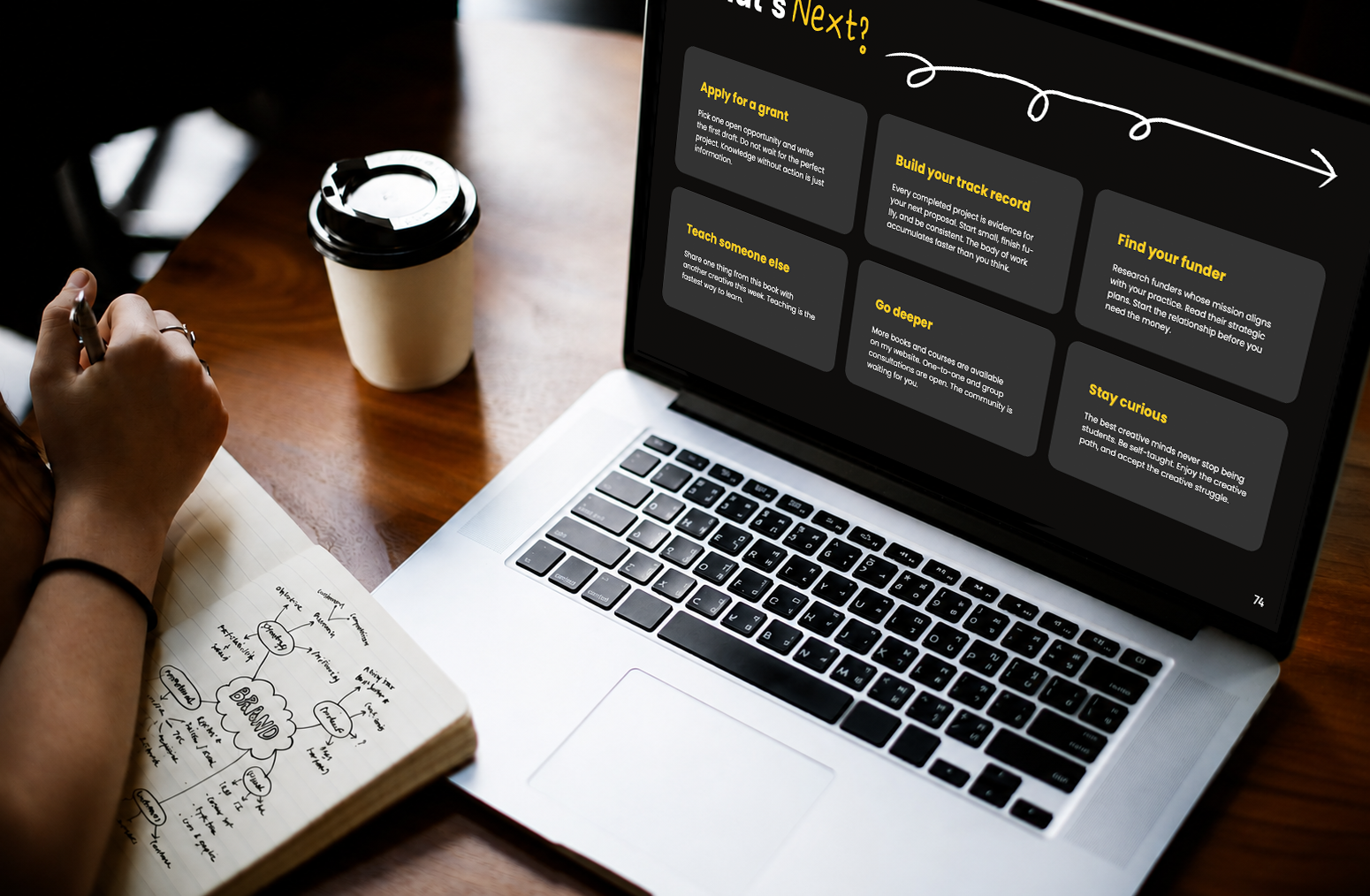
Toolkits & Resources
Each toolkit takes one part of a creative career, funding, sustainability, pricing, or direction, and breaks it into frameworks, real examples, and practice labs you fill in as you go. Everything in them was used on live studio projects before it was ever sold.
Free and paid downloads.
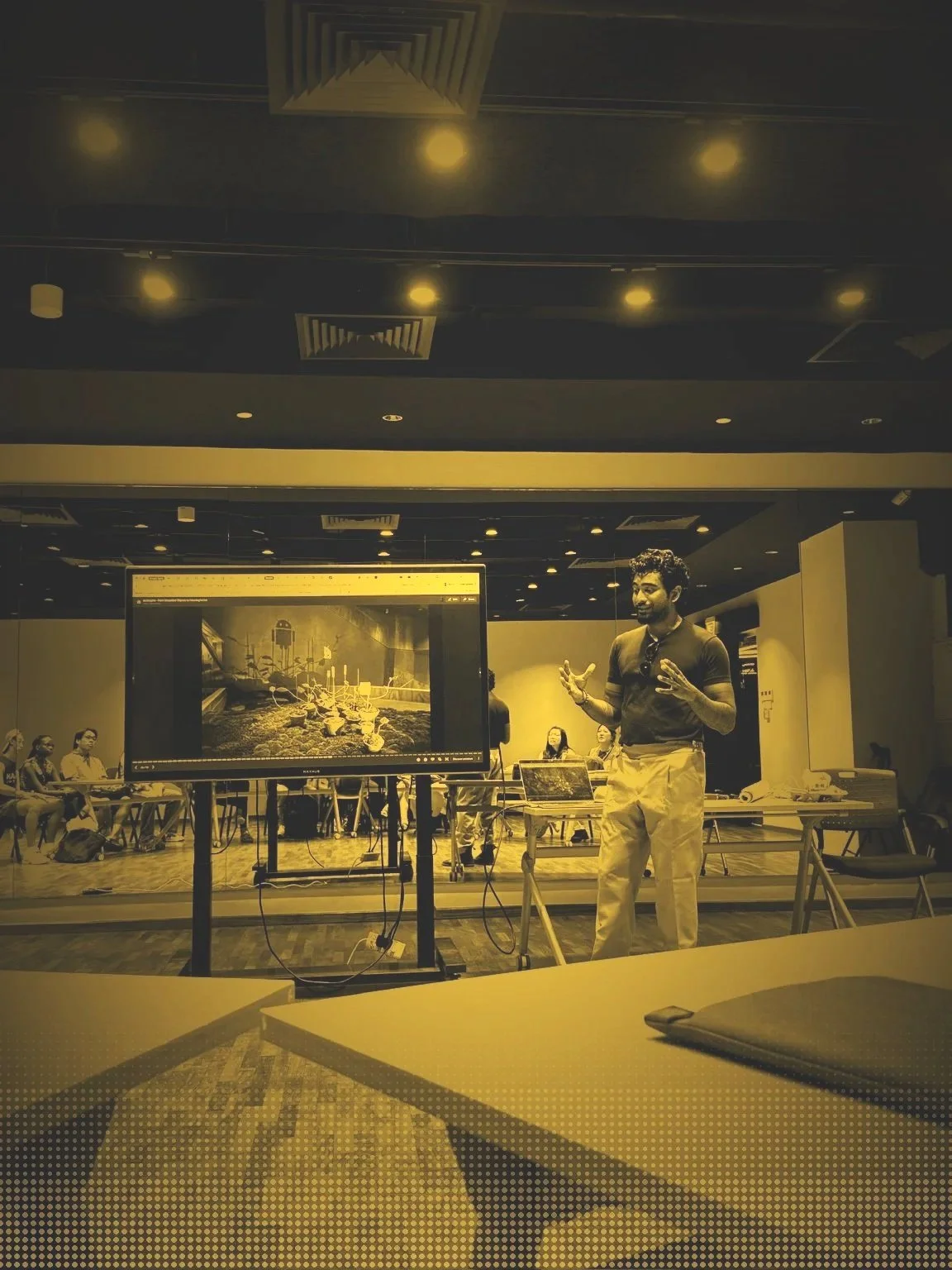
Workshops
Delivered live to schools, faculties, and creative organisations, and drawn from a decade of running a creative studio business.
-
What to expect
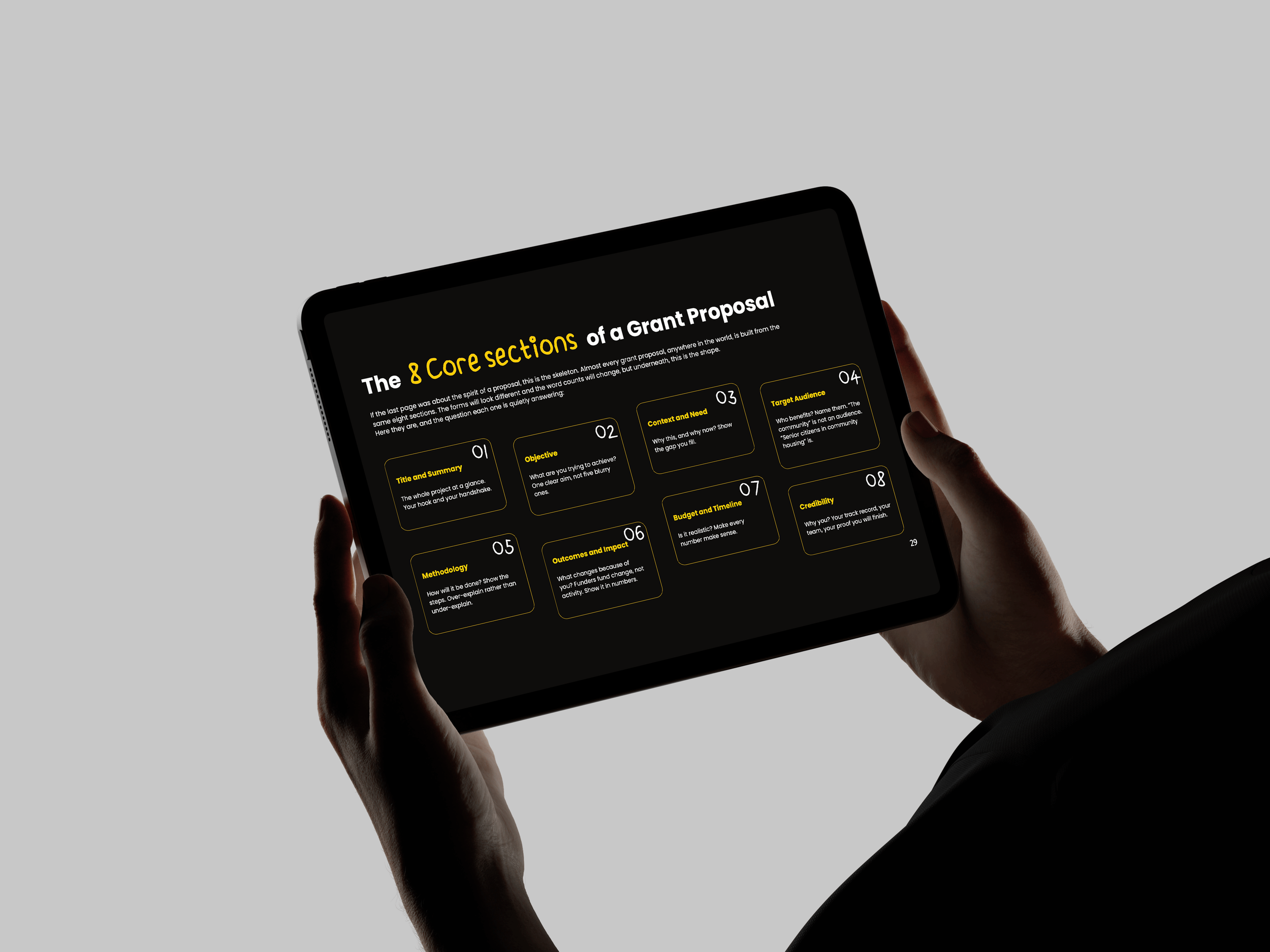
Funding rarely goes to the best idea in the room. It goes to the idea that is easiest to say yes to. This session takes apart what makes a proposal or pitch deck persuasive, then rebuilds it around a project of your own. Real examples, working frameworks, and enough structure to start writing the same week.
What you leave with
The anatomy of a proposal and a pitch deck, section by section
The ability to communicate value in the first thirty seconds of a reader's attention
A method for tailoring one idea across funders, clients, and institutions
The beginnings of a real proposal or deck, shaped in the session
What we cover
Anatomy of a strong proposal and pitch deck
Audience, intent, and strategic positioning
Narrative structure: problem, solution, impact
The common mistakes that lose submissions before the budget page
Format
60 to 75 minutes. Online via Zoom. Interactive, with open Q&A. -
What to expect
Most creative careers are built by accident. This session replaces guesswork with a map. You look honestly at where you are now, name where you want to be, and work out what actually stands between the two. Guided prompts, open discussion, and practical exercises, so you leave with something written down rather than a feeling.
What you leave with
A clear read on the three pathways, employment, freelance, and building your own practice, and the real trade-offs of each
Language for your own strengths, values, and motivators
An honest list of the gaps in skill, exposure, and network
A short-term and long-term roadmap you can act on this month
What we cover
The three pathways and what each one costs
Self-audit: strengths, values, direction
Turning goals into milestones
Risk, resilience, and how momentum is actually built
Format
60 to 75 minutes. Online via Zoom. Interactive, with open Q&A. -
What to expect
Talent is rarely the constraint. Practices stall on branding, pricing, sales, and systems, none of which are taught in art school. This session covers all four using real scenarios rather than theory, so what you take away survives contact with an actual client.
What you leave with
The four pillars: branding, marketing, sales, operations
A way to articulate your creative value so it can be paid for
A working approach to pricing, quoting, and client conversations
The confidence to approach opportunities above your current level
What we cover
From creative talent to strategic practice
Branding, marketing, and positioning
Sales, client management, and the systems behind both
Practice lab: real-world application
Format
60 to 75 minutes. Online via Zoom. Interactive, with open Q&A. -
What to expect
The risk with AI is not that it gets things wrong. It is that it gets things convincingly enough that you stop checking, and slowly stop thinking. This session is for creatives who want the speed without the surrender. You learn where AI genuinely accelerates creative work, where it quietly degrades it, and how to build a working method that keeps your judgement at the centre.
Practical and hands-on. You bring a live project and leave with a workflow you will actually use.
What you leave with
A clear line between the work AI should touch and the work it should not
The two-gate check before accepting any AI output: does correctness matter here, and can you verify it
Prompting as a thinking discipline rather than a trick, including how to argue with a model instead of accepting it
A repeatable workflow for research, drafting, and iteration in your own practice
A position you can defend when a client, a funder, or a peer asks how AI is used in your work
What we cover
Human-nurtured intelligence: what AI is genuinely good at, and what it only appears to be good at
Where authorship is lost, and the habits that give it away
Prompting, critique, and iteration as a working method
AI in creative production: research, writing, concepting, admin
Ethics, disclosure, and client conversations about AI
Practice lab: building your own co-pilot workflow
Format
60 to 75 minutes. Online via Zoom. Interactive, with open Q&A.
-
"His talks and workshops have contributed directly to the growth of emerging creatives. Never one to rest on his laurels, he keeps evolving as an artist, a business owner, and an educator."
Audrey T.
LASALLE College of the Arts -
"He introduced himself with quiet confidence and spoke about making art accessible through murals. A decade on, that is exactly what Mural Lingo has become."
Sharifah S.
Nanyang Academy of Fine Arts (NAFA) -
"I learned real skills in the use of AI that I will use in my school activities and materials. I used to treat it as a search engine. I am now on a new level."
Javier
Teacher, Portugal -
My biggest takeaway is that AI is a powerful partner, not a replacement for human thinking. It supports the work while I stay responsible for the critical thinking and the final decisions.
Gabriela
Teacher, Portugal